Building a watering system for my balcony
My balcony faces south on the 4th floor in Berlin. In summer that means it absolutely bakes. Several days of direct heat in a row, and if you forget to water your plants for even 2 to 3 days, they’re gone.
We had been through this once already. It’s painful to watch your plants die like that, and it’s also a waste of plants, money, and time.
So I decided to fix it properly. I finished a masters in control engineering, and over a decade ago I spent a lot of time with microcontrollers and electronics. I hadn’t had a good excuse to get back into it since, and this felt like the perfect one. What if I could build a small, controlled watering system that adjusts to the moisture of the soil and the weather outside?
The scope, and where I was wrong
My initial scope was ambitious: a wifi-enabled controller so I could adjust things remotely, the ability to water a few plants on the balcony, and moisture sensors driving electronic valves to regulate the flow of water.
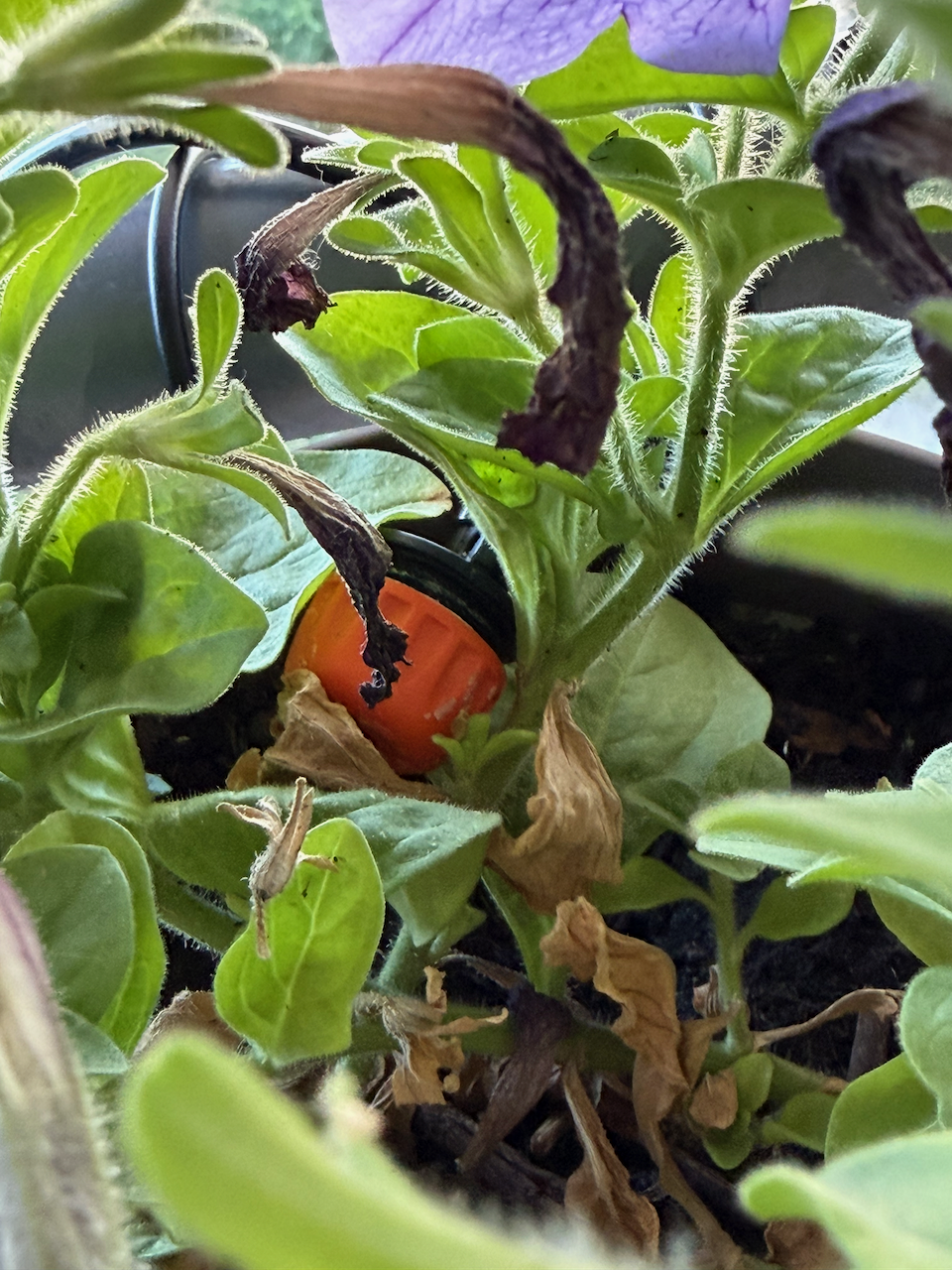
The moisture sensors turned out to be very low quality and never gave reliable readings, so I dropped the idea, along with the solenoid valves, and replaced them with micro-drippers from a Gardena garden watering system.
A classic lesson to start from the simplest thing and add scope only if you prove initial value :)
No taps on Berlin balconies
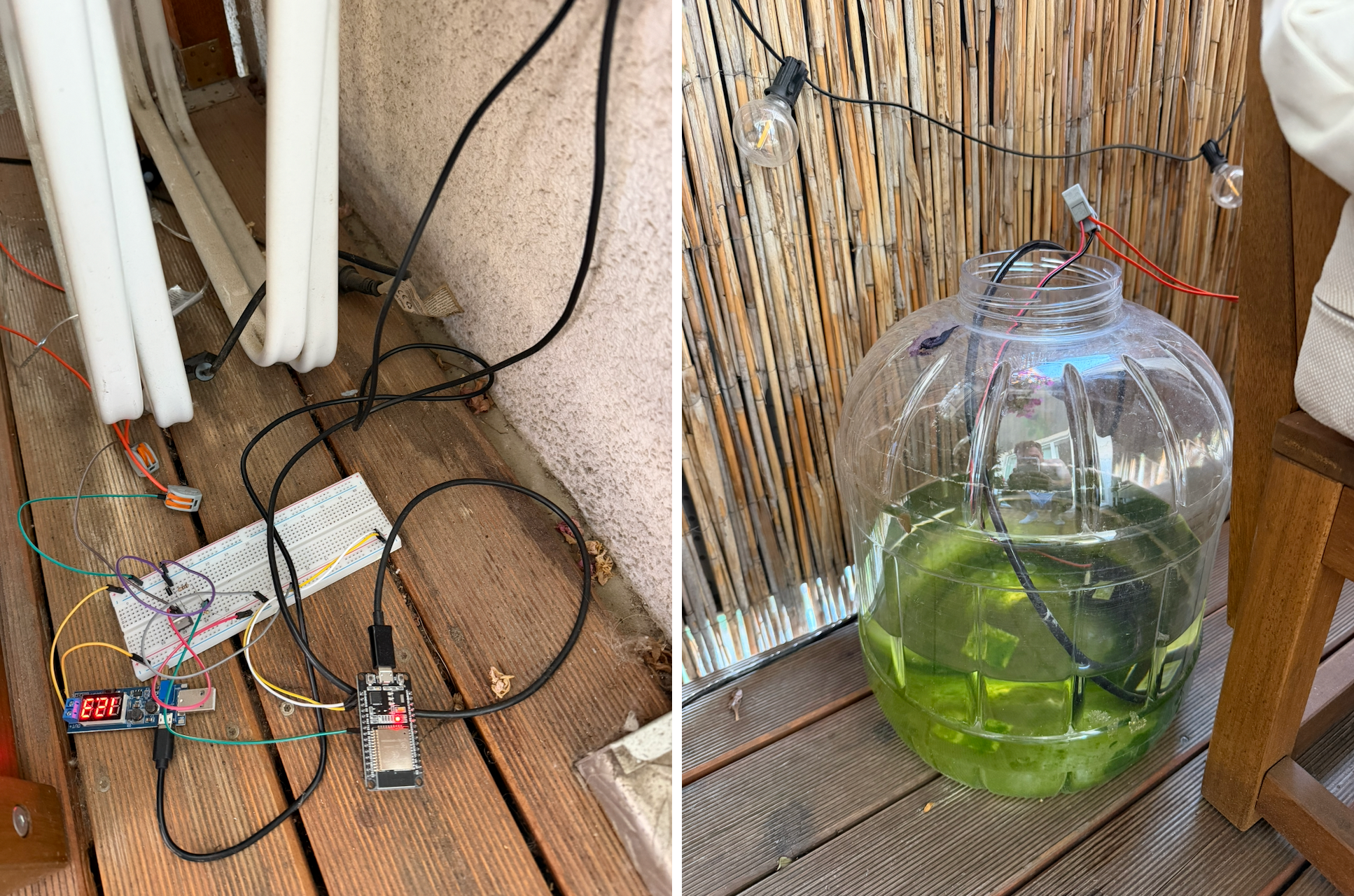
The biggest constraint had nothing to do with electronics. In Berlin apartments you don’t get running water on the balcony, so the whole system has to carry its own water and generate its own pressure.
I solved it with a carboy — the kind used for home wine production, bought at a local construction market — and a 12V pump that pushes water from the carboy through the drip lines. Refillable, self-contained, and it sits happily in the corner of the balcony.
The components
The core build stayed small:
- MOSFET to switch the water pump from the ESP32 — eBay
- Schottky diode for the pump’s flyback spike — eBay
- Boost converter stepping 5V up to 12V to power the pump — eBay
- 12V water pump — eBay
- ESP32 starter kit as the controller — Amazon
The extended scope I ended up shelving:
And the Gardena-compatible micro-drip parts that replaced the valves:
- Pipe (4/7mm) — Amazon
- Drippers and holders — Amazon
- T-connectors — Amazon
- Carboy for home wine production, from the local construction market
The electrical diagram
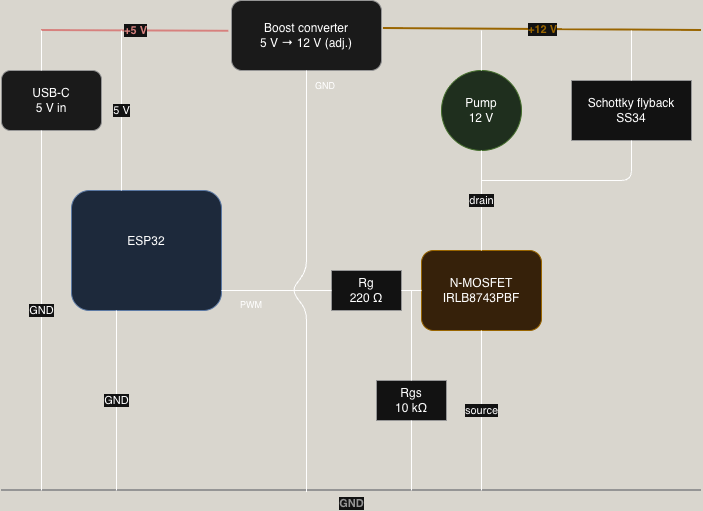
The wiring is quite simple and I entirely built it on a prototyping board. A single USB-C 5V input feeds everything, and one MOSFET does all the switching. I used Claude to remind me all the nuances of how to keep the MOSFET switching safe.
USB-C 5V powers both the ESP32 and a boost converter that steps 5V up to an adjustable 12V. The ESP32’s GPIO drives the gate of an N-MOSFET with PWM.
The MOSFET low-side switches the 12V pump: pump positive to +12V, pump negative to the drain, source to ground. A 10kΩ resistor pulls the gate to ground, holding the FET off during ESP32 boot and reset.
A Schottky flyback diode clamps the pump’s inductive turn-off spike, cathode to +12V and anode to the drain. Three rails run through it all: +5V from the USB/boost input, +12V from the boost output to the pump, and a common ground tying the USB-C, ESP32, boost, MOSFET source, and diode return together.
The code
The firmware lives on GitHub and was generated in 2025, mainly with the help of GitHub Copilot back then: github.com/jniechcial/hydration-station.
The control plane
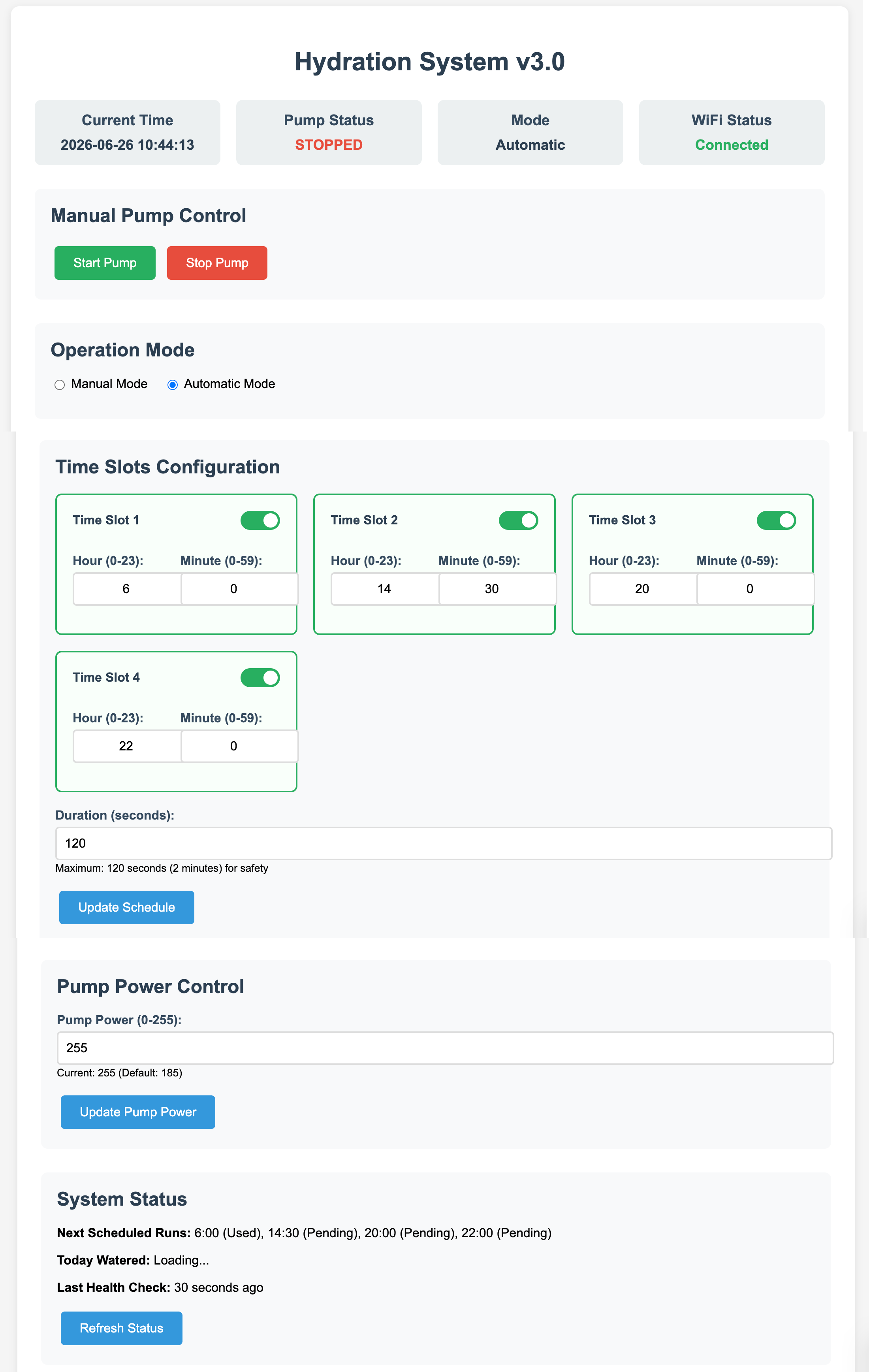
I didn’t want to depend on the cloud for something this small, so the ESP32 serves a simple website on my local network. Everything I need to run the system — trigger a watering, set a schedule, check the state — is a page on my LAN, no app and no external service.
Lessons, and what I’d do next
It’s a very reliable basic watering system, but it still needs a bit of manual oversight for the best outcome, especially during extremely hot spells. That said, it did keep the flowers alive during 2 weeks we were away on holiday, with a neighbour just topping up the water tank twice in that time.
The main limitation is that the watering is uniform, but the plants are not. You can tune each dripper, but what you really want is per-plant logic: water this one once a day, that one twice. Leave the system with a lot of active time to keep the thirsty pots happy, and the smaller pots quietly get over-watered.
I’d love to get back to the valves-and-sensors idea. If I could find moisture sensors I actually trust, there’s still the visual problem of routing meters and meters of individual power and control cables around the balcony without it looking like a bomb.
Moving everything off the prototype board onto a proper custom PCB, with a 3D-printed enclosure, would be the satisfying finish. Maybe at some point, if I find the time!